Skilled nursing facilities provide 24/7 licensed medical supervision with LPNs and RNs for complex conditions requiring continuous care, while assisted living communities focus on basic medical support and daily activity assistance in a more homelike setting. You'll need a physician's order for skilled nursing admission, whereas assisted living evaluates semi-independent living capability through needs assessments. Cost differences are substantial – assisted living in Concord, NH averages $5,500 monthly, with skilled nursing commanding higher rates. Understanding these key distinctions enables ideal long-term care planning.
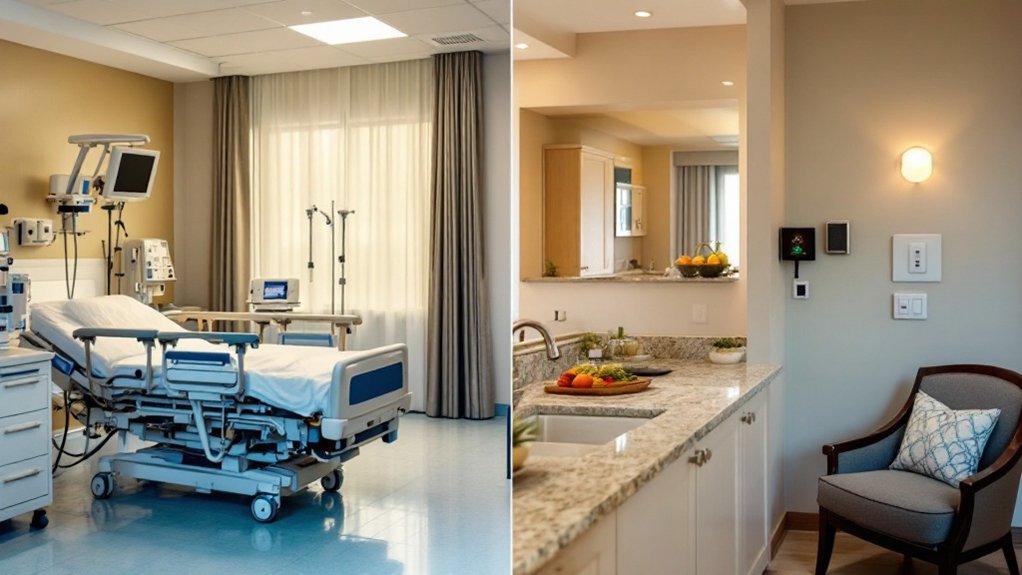
When evaluating long-term care options, understanding the fundamental distinctions between skilled nursing facilities and assisted living communities becomes essential for making an informed healthcare decision. The variation in medical supervision represents a primary differentiator, as skilled nursing facilities maintain 24/7 coverage with licensed nursing staff, while assisted living provides more basic medical support focused on medication management and non-complex health monitoring.
You'll find skilled nursing facilities equipped to handle complex medical conditions requiring continuous care, including post-surgical recovery and chronic illness management, with extensive rehabilitation services encompassing physical, occupational, and speech therapy. The clinical environment features medical equipment and semi-private rooms designed for immediate medical access, staffed by Licensed Practical Nurses and Registered Nurses under physician oversight, alongside specialized therapy professionals. The environment prioritizes hospital-like settings to maintain the highest level of medical care and safety.
Assisted living communities, conversely, emphasize a residential atmosphere with private apartments featuring kitchenettes and personal bathrooms, focusing on maintaining your independence while providing support for daily activities like bathing, dressing, and meal preparation. The staffing model centers on caregivers trained in basic medical support and daily assistance rather than complex medical interventions, though medication management services remain available. In Concord, NH, the average monthly cost is approximately $5,500 for assisted living. Many residents choose this option because they can maintain independent lifestyles while having access to support when needed.
The admission processes reflect these distinct service levels, with skilled nursing typically requiring a physician's order and often following hospital stays, while assisted living evaluates your ability to maintain semi-independent living through extensive needs assessments.
Your financial considerations should account for the significant cost differential, with skilled nursing commanding higher rates due to intensive medical services and specialized staffing requirements.
Both environments offer communal dining and activity spaces, though you'll notice assisted living's deliberate emphasis on creating a homelike atmosphere compared to skilled nursing's more clinical setting.
The care planning process involves family participation across both options, but skilled nursing's medical complexity necessitates more rigorous oversight and adjustment protocols, particularly in managing rehabilitation progress and chronic condition maintenance.
Frequently Asked Questions
How Often Can Family Members Visit Residents in These Facilities?
You'll find standard visiting hours typically span from early morning to late evening in both facility types.
While assisted living offers more flexibility with minimal restrictions, skilled nursing maintains structured schedules.
You're generally permitted daily visits, though you'll need to follow current pandemic protocols limiting visitors to two per resident.
You can arrange special visiting hours outside standard times through advance coordination with facility administrators.
What Payment Options and Insurance Plans Are Accepted for These Services?
Your payment options include Medicare coverage for skilled nursing (up to 100 days post-hospitalization), Medicaid for long-term care (eligibility varies by state), long-term care insurance, and private insurance plans.
While skilled nursing facilities typically accept Medicare/Medicaid and average $15,000 monthly, assisted living costs around $4,500 monthly and relies more on self-payment or specialized long-term care policies.
VA benefits and reverse mortgages provide additional funding alternatives.
Are Pets Allowed in Assisted Living or Skilled Nursing Facilities?
You'll find that pet policies vary considerably between facilities, with assisted living generally being more accommodating than skilled nursing facilities.
While assisted living typically allows up to two pets per resident with specific breed and size restrictions, skilled nursing facilities often maintain stricter limitations due to their medical focus.
Both environments require up-to-date vaccinations, and you're usually responsible for pet care, though some facilities offer assistance programs or pet therapy alternatives.
What Security Measures Are in Place to Protect Residents?
You'll find extensive security measures protecting residents through layered systems, including biometric scanners, key-card access controls, and CCTV surveillance monitoring common areas.
Motion sensors and bed/door alarms detect unauthorized movement, while GPS tracking devices monitor resident locations.
Physical safeguards incorporate well-lit spaces, secure outdoor areas, and restricted access points, complemented by thorough staff training and strict visitor management protocols.
Can Residents Bring Their Own Furniture and Personal Belongings?
Your furniture and personal belongings options differ considerably between care settings.
In assisted living, you'll have considerable flexibility to bring furniture, decorations, and cherished items to create a home-like environment within your private space.
However, in skilled nursing facilities, you'll face more restrictions due to space limitations and safety protocols, typically allowing smaller personal items while larger furniture requires pre-approval from facility management.