
In the first three quarters of 2025, the senior housing and nursing care sectors experienced a robust transactional landscape, with total volumes reaching $16.3 billion, a significant increase of over $5 billion compared to the previous year. Remarkably, senior housing alone accounted for $10.3 billion of this total, with more than 1,000 properties changing hands, marking a 7% increase from 2024. The third quarter alone recorded $4.22 billion in senior housing deals, underscoring a vigorous market resurgence. Strong occupancy rates have supported this momentum, as evidenced by the occupancy rate reaching 88.1% in Q2 2025.
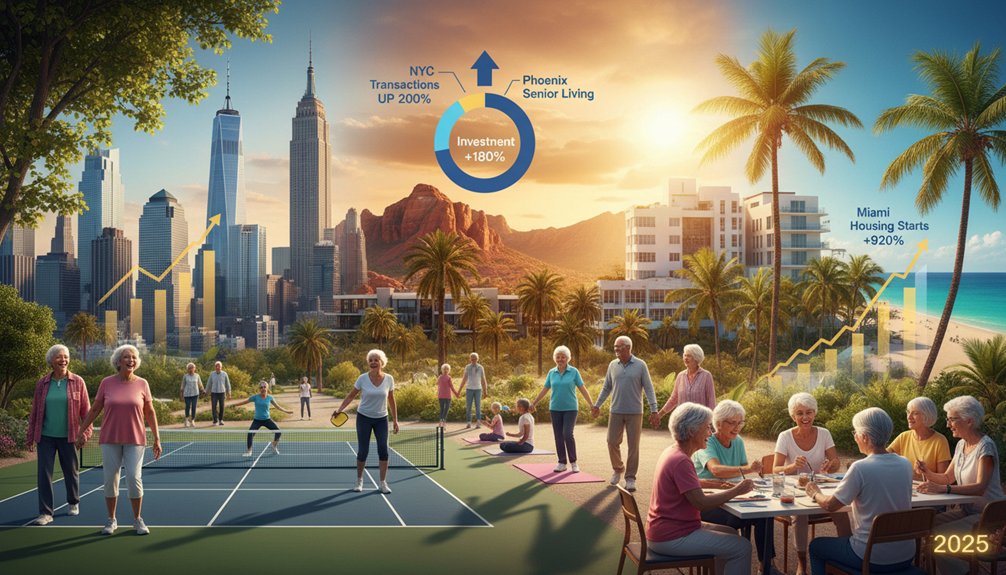
New York City emerged as the leading market, achieving a transaction volume of $766 million across 13 properties, where the average price per unit reached $311,525. This positioned NYC at the forefront among the top ten metropolitan areas for senior housing investments, with transaction volumes in these markets ranging from $227 million to $767 million through Q3.
New York City leads senior housing investments with $766 million in transactions and an average price per unit of $311,525.
Similarly, Phoenix secured second place with $530 million in transactions involving 16 properties, with an average price per unit of $267,950, indicating its rise as a key hotspot for investment alongside NYC and Miami.
Miami ranked third with $440 million in transaction volume through 16 properties, where the average deal price per unit stood at $139,272. This broad-based investor interest highlights Miami’s strategic significance as it contributed to the national resurgence in transaction activity.
On a national scale, the average price per unit climbed to $175,000, reflecting a 43% year-over-year increase, driven by continuous price growth over six months. The Dallas metro area, for instance, achieved an average of $187,375 per unit across 25 properties, totaling $418 million. The U.S. will be short 550,000 senior living units by 2030, emphasizing the urgent need for expansion in this sector.
With a projected shortage of 550,000 units by 2030 and an 88.1% occupancy rate as of Q2 2025, the demand for senior housing remains paramount. Developers must triple their construction pace to meet this burgeoning need, fueled by strong fundamentals and investor conviction.