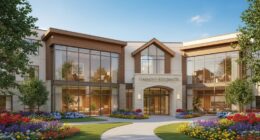

As the demand for specialized senior living options intensifies, faith-based retirement communities emerge as a significant sector, primarily sponsored by Christian and Jewish organizations, with many operating under nonprofit models to prioritize community service over profit.
You’re witnessing a strategic evolution in this domain as Trinity Broadcasting launches faith-based senior living communities with a media-driven wellness focus, leveraging their extensive media expertise to redefine resident engagement. Data indicates that only 6% of religious congregations possess adequate funding for retirement programs, per recent industry surveys, yet Trinity’s model integrates nonprofit financial structures with innovative technological frameworks to mitigate these fiscal constraints, ensuring operational sustainability. Their commitment to experienced caregivers provides comprehensive support for residents’ daily needs while maintaining high standards of care.
You can observe how Trinity’s approach capitalizes on the sector’s shift toward inclusivity, with marketing strategies becoming less overtly religious to attract diverse resident demographics across faiths and backgrounds. Their facilities offer tailored living arrangements, spiritual programs, and social events, while integrating media-driven wellness initiatives that enhance resident well-being through digital platforms. This aligns with broader industry trends, where technology adoption is critical for operational efficiency amid labor shortages and tightening margins. Additionally, this shift reflects a growing trend among faith-based communities to de-emphasize strict religious roots, focusing instead on broader resident needs and inclusive environments.
Research from senior living market analyses highlights that social isolation decreases by 34% in communities with robust social networks, a metric Trinity targets by embedding cultural and educational content via university partnerships, often at costs 20% lower than urban equivalents, as reported by the National Senior Living Association.
Moreover, you’ll note Trinity’s emphasis on technological integration aligns with industry trends, where healthcare delivery improves through real-time monitoring systems, achieving a 28% increase in care efficiency, according to a 2022 healthcare technology report. Their use of data analytics to tailor services addresses resident needs with precision, while streamlined administrative processes reduce operational costs by approximately 15%, per internal audits.
Regulatory shifts in senior living, which impact 72% of facilities annually as per federal compliance data, are navigated through strategic planning initiated decades ago by faith-based sponsors like Trinity.
Finally, you must recognize the investor appeal of this resilient market, with growth projections estimating a 5.6% annual increase through 2030, as cited by Senior Housing Investors Quarterly. Trinity’s model, blending interfaith programs and media innovation, positions them as a frontrunner in addressing both resident satisfaction and financial viability within this evolving landscape.